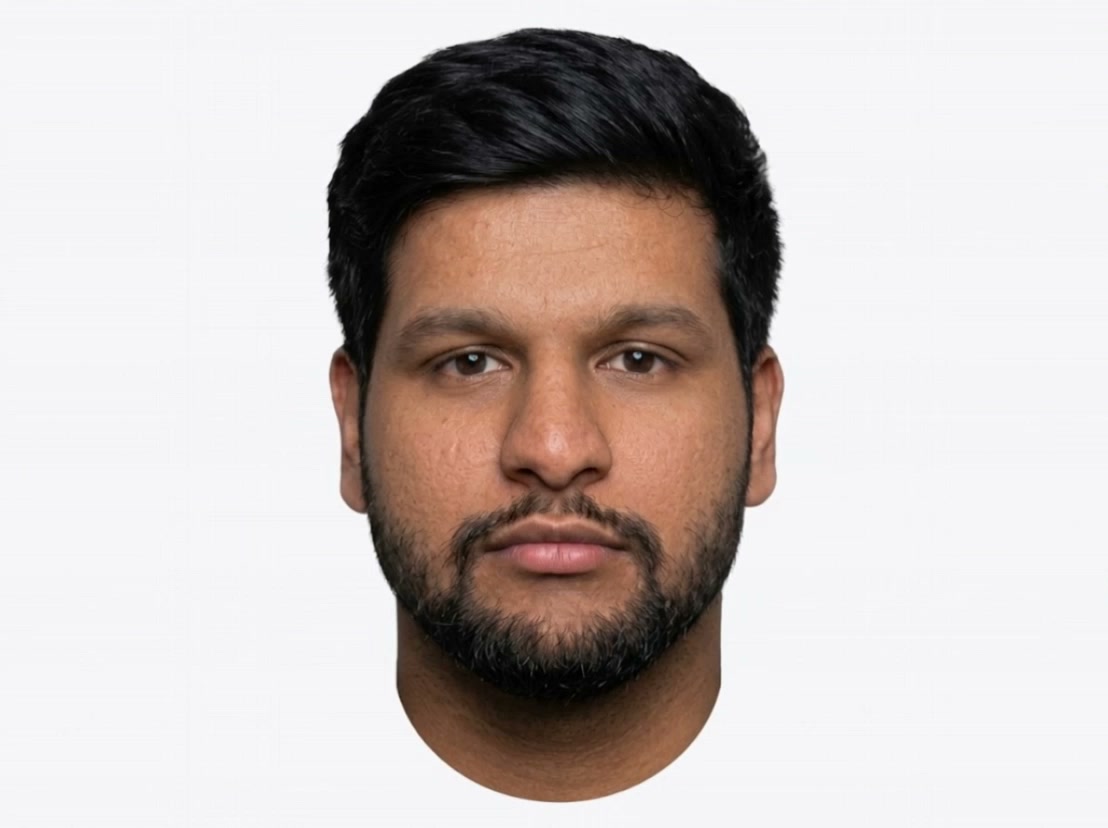
Neil Saldanha
Turned myself to ash
because I was bored.
Scroll
Neil Saldanha
Steps
Started with Gemini to generate a clean, photorealistic studio portrait instead of using a real photo, so the whole thing could be shown as fully AI generated from the very first frame.
Gave Claude Code the image with one instruction: this is the snippet, build a hero animation around it. From there, Claude Code planned and ran the entire generation pipeline against the Higgsfield API.
Before generating anything, a hard $2 ceiling was set on the whole experiment. The rule was to stay under it, not spend up to it.
Instead of trusting Higgsfield's published rates, live cost estimates were pulled straight from the API's own /estimate endpoint. It's free to call and more accurate than any rate sheet.
Wan 3.0 looked like the obvious pick until the estimate confirmed its 1080p rate was a real $0.20 per second. Kling 2.5 looked cheaper on paper, but every endpoint came back model_not_found, it had been retired from the live catalog. Landed on Kling 3.0 Standard: under half the cost of Wan 3.0, and known for holding a single continuous take well.
The face turned left instead of right, and the dissolve effect only showed up in the last two seconds instead of building across the whole clip.
The prompt said "turns to the right" without saying whose right, and never told the model how to divide the 8 seconds between the turn and the dissolve. So it guessed at both.
Pinned the direction to screen right explicitly and gave the dissolve its own time window instead of leaving it to chance. Same model, same budget tier, just a clearer set of instructions.
Tools
 Higgsfield
 Claude
 Gemini